Industry · AI Data Center
The grid answers in minutes. GPUs trip in milliseconds.
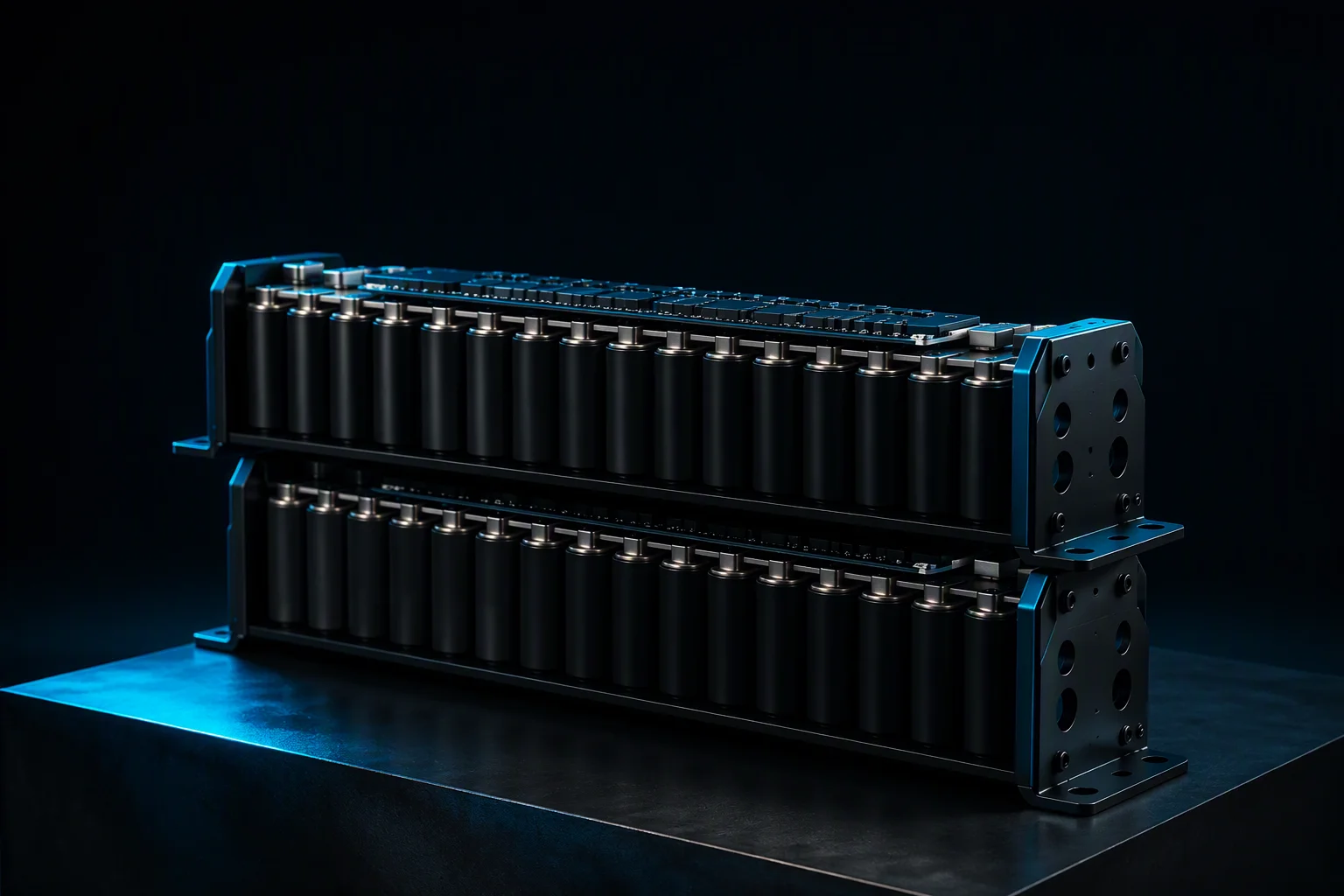
A GB300-class rack draws 132–142 kW and steps load between compute passes — a window the utility can never serve, so the rack has to carry its own bridge.
Pain points, quantified
Why AI racks stall — and what each stop costs
Every number below comes from published field data or vendor platform documentation. Together they describe one structural problem: the time constants of generation, distribution and compute no longer overlap.
| Failure mode | Number | Why it matters |
|---|---|---|
| Unplanned training stops | 419 interruptions in a 54-day Llama 3 405B run | One stop roughly every 3.1 hours across a 16K-GPU cluster; every event risks checkpoint loss |
| GPU-attributed faults | 58.7% of those unplanned stops | Silicon faults dominate the ledger — and power quality decides how far each one cascades |
| Rack power swing | 132–142 kW per GB300-class rack (~1,580 kg) | Load steps land between compute passes, faster than any mechanical or grid-side response |
| Grid generation ramp | 1–90 minutes to follow demand | Generation cannot chase millisecond load steps; transients must be absorbed inside the rack |
| PSU efficiency ceiling | 94.5% efficiency, ~120.8 kW rack peak | Conversion losses leave little thermal headroom for ungoverned current spikes |
| Peak grid demand | Up to 30% cut with rack-integrated storage | Demand charges and interconnect limits — not floor space — gate cluster expansion |
| Storage inside the PSU | 65 J/GPU; capacitors take ~50% of PSU volume | Energy has moved into the power stage itself; module form factors follow it there |
The same published post-mortem put hardware faults behind about 78% of interruptions — and industry estimates now put AI-server supercapacitor demand on a double-digit growth curve through 2032. Both trends point the same way: the millisecond tier has become a design requirement, not an accessory.
Reference architecture
Three tiers, one handoff boundary
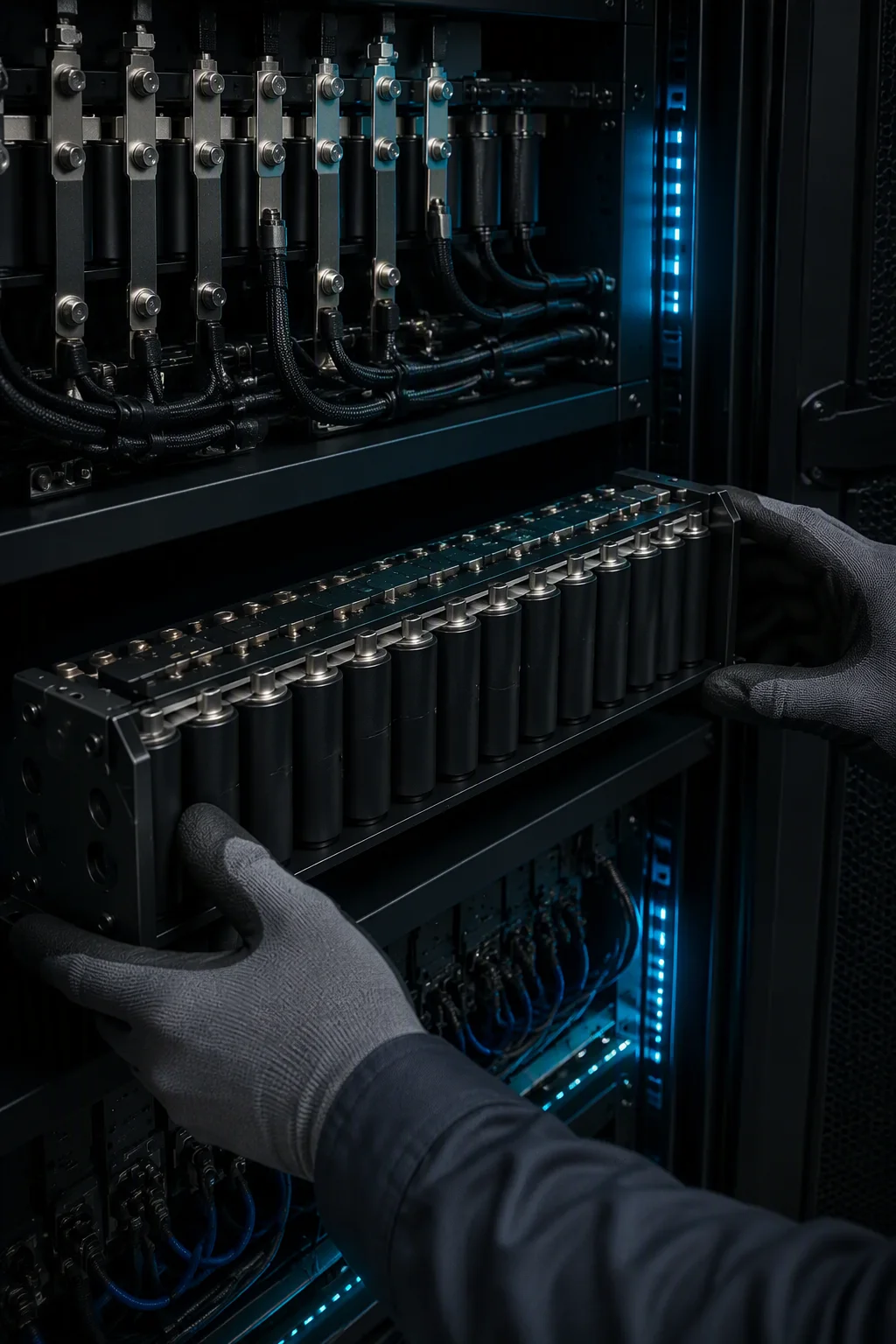
Modern AI power is layered by time constant. LIC hybrid supercapacitors own the 1–50 ms tier — they charge between transients, discharge instantaneously, and cycle all day without measurable wear. Lithium BBU shelves take over from seconds to minutes, sized around 33 kW per 1U-class unit in current GB300-compatible designs. Behind them, UPS or HVDC plant carries the minutes-to-hours load while generation ramps.
The boundary matters as much as the tiers. The capacitor tier never exports energy upstream — it exists to make rack power look flat to everything behind it. That is also why LIC wins the first tier: 3.8/4.0 V cells mean roughly 30% fewer cells in series than EDLC at the same bus voltage, and about 10× the energy of same-size EDLC in the same shelf volume.
Time windows
Who covers what, and for how long
| Tier | Time window | Energy job | Typical hardware |
|---|---|---|---|
| Tier 1 · LIC | 1–50 ms | Absorb load steps, bridge to the BBU tier | 48V module in the power shelf; PSU-embedded packs in the 65 J/GPU class |
| Tier 2 · Li-ion BBU | Seconds – minutes | Carry racks until plant and grid respond | 33 kW-class 1U BBU shelves, cold-plate compatible |
| Tier 3 · UPS / HVDC | Minutes and beyond | Grid-side continuity while generation ramps (1–90 min) | Central UPS strings or HVDC plant |
CapStack builds for Tier 1 and the handoff: 48.6 V-class modules, ±5% C/ESR-sorted cells and per-cell telemetry over CAN, so the shelf controller can prove the tier below never dropped — event by event, serial by serial.
Integration
From power profile to parallel test
Power profile
Pull the rack's transient envelope: kW step size, duty cycle and worst-case step interval. A 132–142 kW rack swing sets the C-rate before anything else does.
Window definition
Fix the tier boundary — how many milliseconds until the BBU reports ready. That window, with the DC bus voltage window, sets the capacitance target.
Module selection
Map the target to 48V modules or PSU packs; choose active or passive balancing; set CAN alarm thresholds to match the shelf controller's fault ladder.
Parallel verification
Run prototype modules in parallel with the BBU: verify the 1–50 ms handoff, current share at surge, then thermal soak at true rack ambient.

Start the conversation
Send the power curve. We will size the millisecond tier.
Ride-through window, peak-shaving target, rack bus voltage — three numbers get a cell count, an ESR budget and a lead time back within 48 hours.