Technology · Overview
The backup cell trade-off, quantified
Every ride-through design starts with one cell choice: an LIC hybrid supercapacitor, a symmetric EDLC, or a Li-ion battery. The three overlap far less than headline slides suggest — one answers a load step in 1–50 ms, one stores ten times more energy per kilogram, and one carries a failure mode the other two do not have. This hub lays the trade-offs out in datasheet-class numbers before you commit a string count.
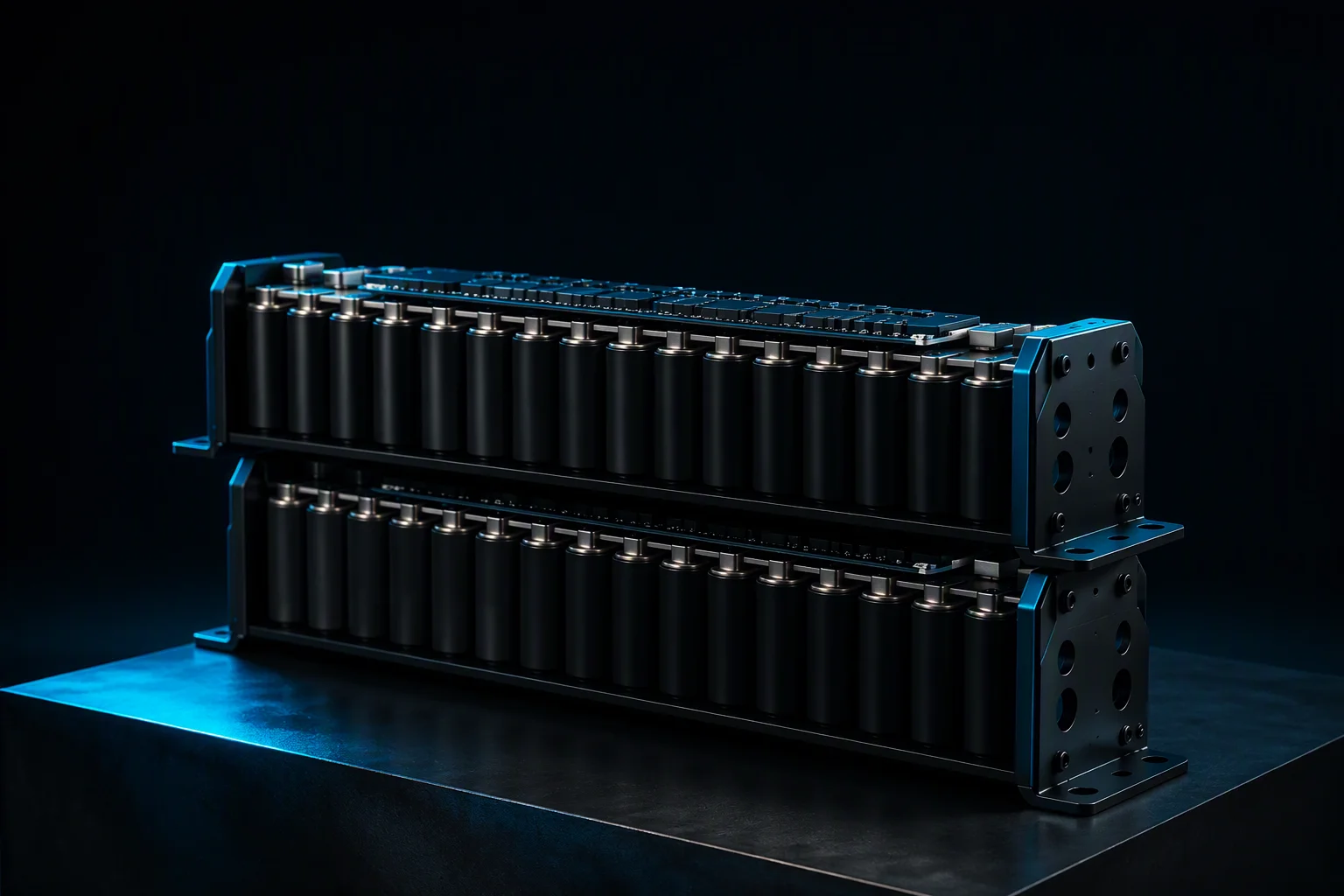
CapStack builds modules on the LIC side of that table — laser-welded, ±5% capacity-sorted, test-reported — because the millisecond tier is where rack power actually lives.
Three chemistries
One decision, three very different cells
LIC hybrid supercapacitor
3.8 / 4.0 V cell — about 30% fewer cells per string than a 2.7 V EDLC at the same bus voltage.
13.7–62 Wh/kg — roughly 10× the energy of a same-size EDLC.
500k+ cycle class in a 3.5→2.5 V window; −40 °C capable by series.
No thermal runaway — physical adsorption plus a prelithiated carbon electrode.
EDLC — symmetric double-layer
2.7–3.0 V cell — the classic double-layer workhorse, mature and widely second-sourced.
3–8.5 Wh/kg, 22–28 kW/kg — a pure power play with little energy reserve.
500k–1M cycles at 25 °C — the cycle-life benchmark.
Higher self-discharge and more cells per string at a given bus voltage.
Li-ion battery
~130–265 Wh/kg — the energy density king for hours-class storage.
1,000–5,000 cycles — high-cycling backup duty consumes the budget fast.
Thermal runaway risk — BMS interlocks and clearance are mandatory design inputs.
Cold limit — charging restricted below 0 °C; −20 °C is a working floor.
Head to head
Ten parameters, datasheet-class numbers
Conditions define every number below — cycle life in particular is always quoted against a voltage window and a temperature. Treat this as the shortlist; the deep-dive page expands it to 14 rows with the measurement conditions spelled out.
| Parameter | LIC | EDLC | Li-ion battery |
|---|---|---|---|
| Cell rated voltage | 3.8 / 4.0 V | 2.7–3.0 V | 3.2–3.7 V |
| Cells per string, same bus voltage | Baseline | ≈30% more cells | Comparable count, shrinking with wear |
| Energy density | 13.7–62 Wh/kg | 3–8.5 Wh/kg | ~130–265 Wh/kg |
| Power density | Up to ~22 kW/kg | 22–28 kW/kg | 0.5–3 kW/kg |
| Cycle life | 500k @3.5→2.5 V / 50k @4.0→2.5 V | 500k–1M @25 °C | 1,000–5,000 |
| Operating temperature | −40…+70 °C by series | −40…+85 °C | −20…+60 °C |
| Response to a load step | 1–50 ms | Milliseconds-class | Electrochemical delay |
| Failure mode | No thermal runaway | No thermal runaway | Thermal runaway risk |
| Self-discharge | ≥3.7 V held after 72 h rest | Higher, days-scale droop | Low |
| Cost position | Mid: above EDLC per farad, far below Li-ion per delivered cycle | Lowest per farad | Highest per delivered cycle in high-cycling duty |
Full 14-row breakdown → Module engineering → Testing & sorting →
In numbers
Why the LIC column wins the backup slot

Chemistry, settled
Send the ride-through window, get the cell count back.
CapStack answers every RFQ within 48 hours with a chemistry recommendation, a capacitance figure and a lead time — not a brochure.