Deep comparison
Why LIC owns the millisecond tier
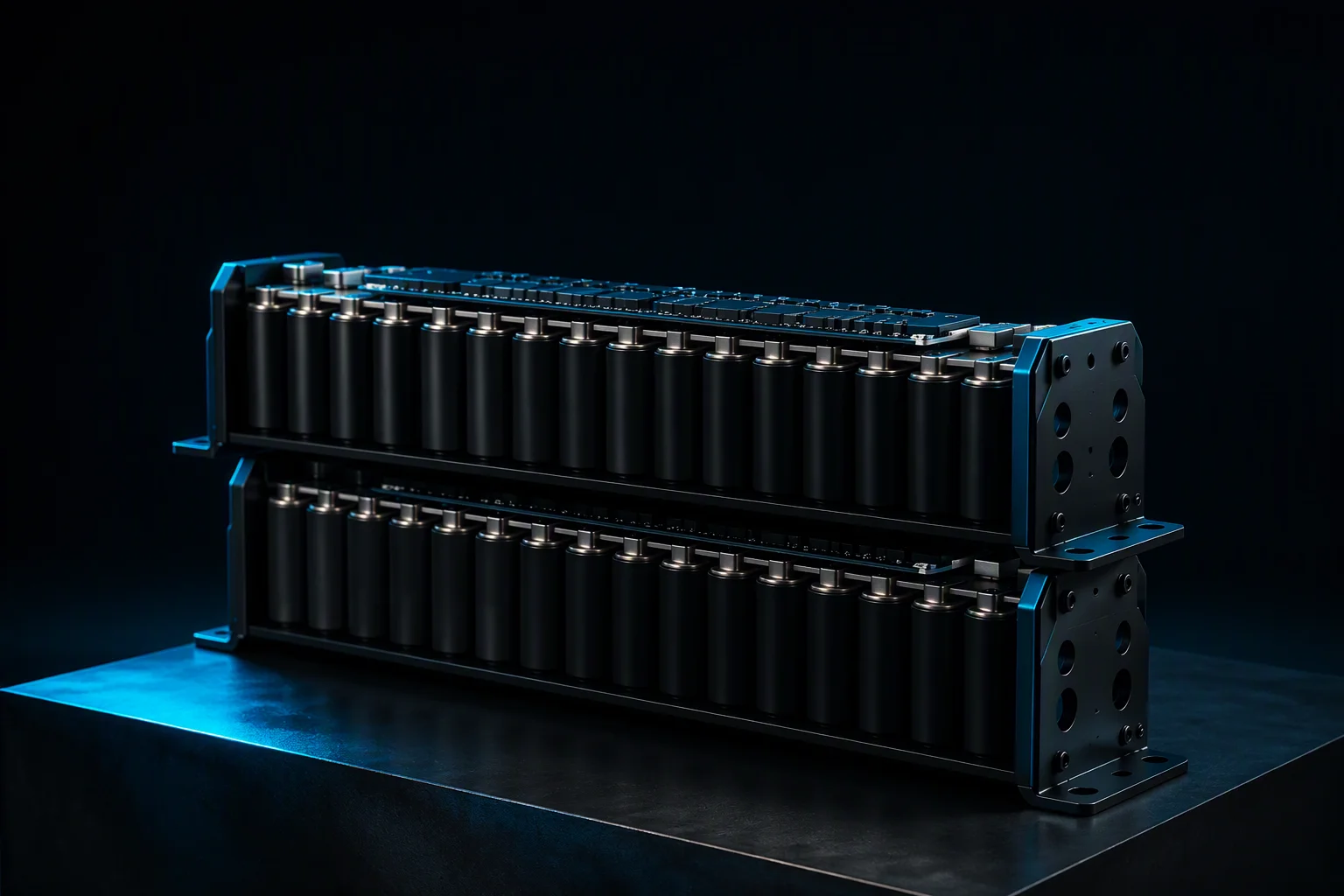
Backup power fails in one of two ways: too slow to catch the sag, or too short-lived to survive the duty cycle. The three candidate cells part company exactly there. An LIC hybrid supercapacitor answers a load step in 1–50 ms and keeps doing it for a 500,000-cycle class at a 3.5→2.5 V window. An EDLC matches the speed but carries roughly a tenth of the energy per kilogram. A Li-ion battery stores the most energy of all, yet budgets you 1,000–5,000 cycles and a cold-weather exit plan.
This page compares all three across 14 parameters, then opens the LIC cell itself — because knowing why it behaves differently is what makes the numbers believable.
Fourteen parameters
The full comparison table
Numbers below are datasheet-class: real values from manufacturer specifications, not lab anecdotes. Where a range appears, it is the honest spread across cell series and formats. Cycle life is always conditional on voltage window and temperature — the footnote that decides everything.
| Parameter | LIC hybrid supercapacitor | EDLC | Li-ion battery |
|---|---|---|---|
| Cell rated voltage | 3.8 / 4.0 V | 2.7–3.0 V | 3.2–3.7 V |
| Cells per string, same bus voltage | Baseline | ≈30% more cells at the same bus voltage | Comparable on paper; usable window shrinks with cycling |
| Gravimetric energy density | 13.7–62 Wh/kg | 3–8.5 Wh/kg | ~130–265 Wh/kg |
| Power density | Up to ~22 kW/kg on large cells | 22–28 kW/kg | 0.5–3 kW/kg |
| Cycle life (defined window) | 500k @3.5→2.5 V / 50k @4.0→2.5 V | 500k–1M @25 °C | 1,000–5,000 |
| Operating temperature | −40…+70 °C by series (pouch −25…+55 °C) | −40…+85 °C | −20…+60 °C |
| Behavior at −40 °C | Delivers cranking-class current | Works, capacitance derated | Charging restricted below 0 °C; capacity collapses toward −20 °C |
| Response to a load step | 1–50 ms | Milliseconds-class | Electrochemical delay before full takeover |
| Pulse current capability | 450 A-class cells; >500 A module surge | Multi-kA pulse cells | C-rate limited, typically ≤3 C |
| Safety / failure mode | No thermal runaway | No thermal runaway (no lithium) | Thermal runaway risk; interlocks mandatory |
| Self-discharge | ≥3.7 V held after 72 h rest, cell level | Higher — days-scale voltage droop | Low |
| Calendar life | 15-year design-life class in backup service | 10–20-year class, voltage/temperature dependent | 5–15 years, managed around capacity fade |
| Shipping classification | UN 3499 · Class 9 above 0.3 Wh · IATA PI 971 | UN 3499 · Class 9 above 0.3 Wh | UN 3480/3481 · Class 9 · state-of-charge rules |
| Cost position | Mid: above EDLC per farad, far below Li-ion per delivered cycle in high-cycling duty | Lowest per farad | Highest per delivered cycle when cycling daily |
Read the two middle columns as one system choice: EDLC for raw pulse power where energy hardly matters, LIC where the ride-through window has real joules behind it and the string still has to live a decade.
Inside the cell
Half capacitor, half battery, none of the meltdown
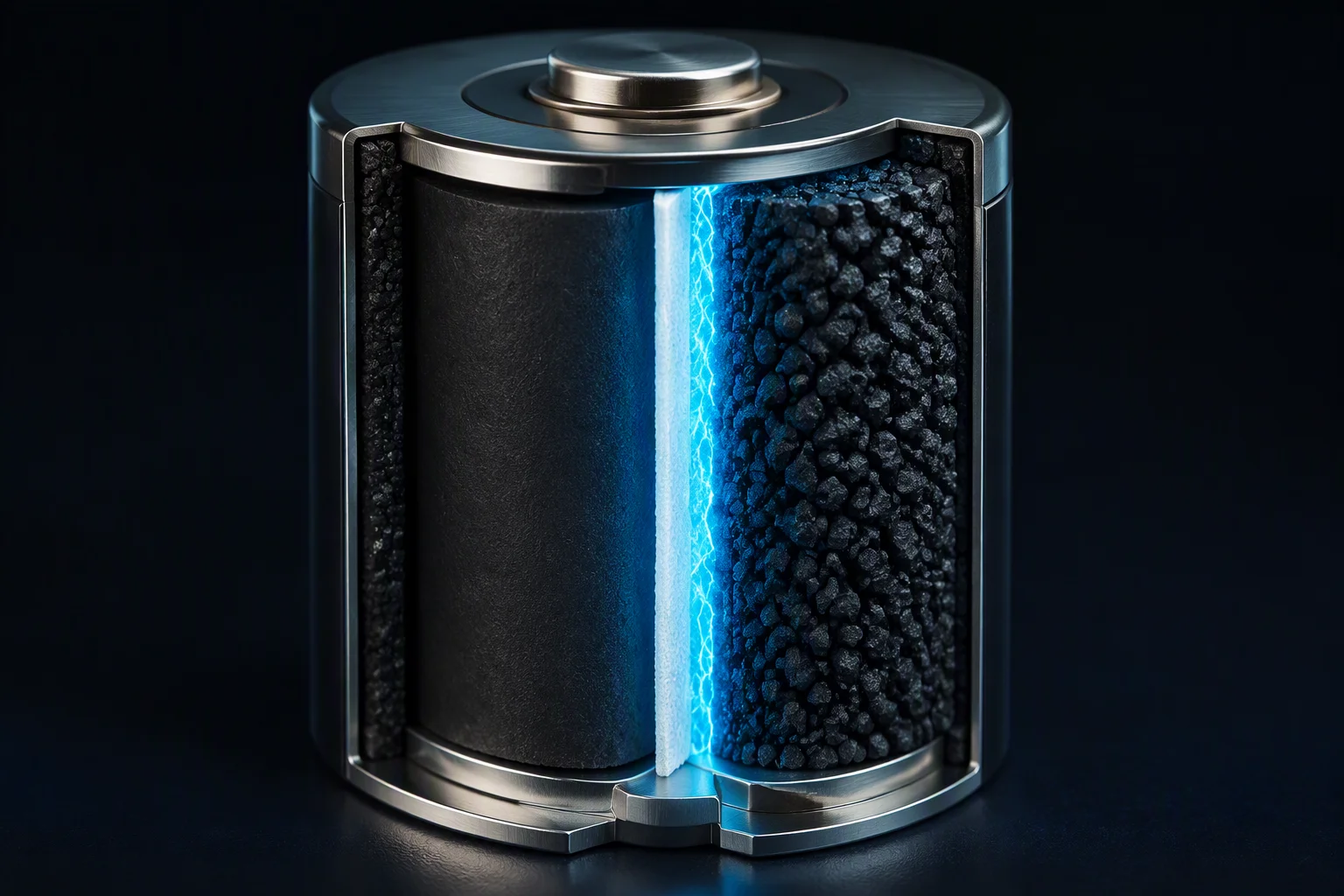
An EDLC stores charge purely physically — ions adsorbing onto activated carbon, reversible almost forever. A Li-ion cell stores it chemically, with lithium intercalating into host crystal structures while a flammable organic electrolyte sits in the circuit. The LIC hybrid supercapacitor runs both mechanisms at once: the positive electrode is capacitor-grade carbon, while the negative is a prelithiated carbon that donates lithium ions without offering a lithium-metal or metal-oxide reaction site.
That split personality explains the column of numbers above. Lithium pre-loaded into the carbon lifts the cell to 3.8–4.0 V, so a 48 V bus needs about 30% fewer cells in series than 2.7 V EDLCs. Adsorption-dominated chemistry holds ≥3.7 V after a 72 h rest and keeps DC ESR down to 0.47 mΩ on large cells. And the two classic runaway chains — dendrite growth and cathode oxygen release — have no starting point, which is why the failure-mode row reads the way it does.
Straight answers
Four questions engineers actually ask

Decision time
The table favors LIC. The module makes it real.
Tell us the ride-through window and bus voltage — you get back a cell count, a ±5% sorted capacitance figure and a lead time, inside 48 hours.