The duty cycle decides which economics apply
Two backup installations can look identical on a single-line diagram and behave like completely different purchases. One fires twenty times a day and is, functionally, a consumable with a service interval. The other fires twice a year and is a capital asset that should outlive the equipment it protects. Total cost of ownership for short-duration backup is decided almost entirely by which of those two you are buying — and the storage technology is a consequence of that answer, not the starting point.
So the comparison below is written around duty, not around chemistry. Where a battery wins, it is stated plainly, because a specification that pretends otherwise collapses at the first design review.
Cycle life: turning the datasheet class into a replacement count
The useful figure is not cycles; it is cycles divided by events per year. Our LIC modules are qualified to a 500,000+ cycle class on a 3.5 → 2.5 V window, which drops to roughly 50,000 cycles if you sweep the full 4.0 → 2.5 V range on every event. Lithium-ion batteries are commonly specified in the 1,000–5,000 cycle band. The table translates those classes into a fifteen-year horizon.
| Duty profile | Events per year | Events in 15 years | LIC @ 500k+ class | Li-ion @ 1,000–5,000 |
|---|---|---|---|---|
| Rack transient absorption, 20/day | 7,300 | ≈ 109,500 | Inside class, ~4.5× margin | Class exhausted in 2–8 months |
| UPS bridge, twice daily | 730 | ≈ 11,000 | Inside class | 2–10 replacement cycles |
| Rail braking recovery, 300/day | 109,500 | ≈ 1.6 million | Only a shallow recovery sweep is defensible at this count | Not a candidate |
| Grid event, a few per year | 2–5 | ≈ 30–75 | Calendar life governs | Calendar life governs |
Read the last row carefully, because it is the honest counterweight to everything above it. For pure standby duty — a device that sits charged for years and works twice — cycling is irrelevant for both technologies and calendar aging governs. Batteries are not disqualified there; a well-managed lithium string in a temperature-controlled room can carry a 5–15 year calendar life. The cycle argument only becomes decisive when events are frequent: thousands of transients a year, hundreds of braking events a day, or a rack that absorbs a load step every time a GPU cluster changes state. That is the duty profile where a battery stops being a capital asset and starts being a maintenance line item.
Replacement interval is a labour cost, not a parts cost
When a battery string reaches the end of its useful life, the expensive part of the event is rarely the cells. It is the scheduled outage, the electrician, the disposal paperwork, the access equipment, and — in the cases that hurt most — the crane. A pitch-drive cabinet ninety metres up a tower does not care what the replacement part costs; it cares that a crew has to mobilize to install it. The same logic applies at rack scale: a data hall visit needs a change window, an escort and a work permit before anyone touches a terminal.
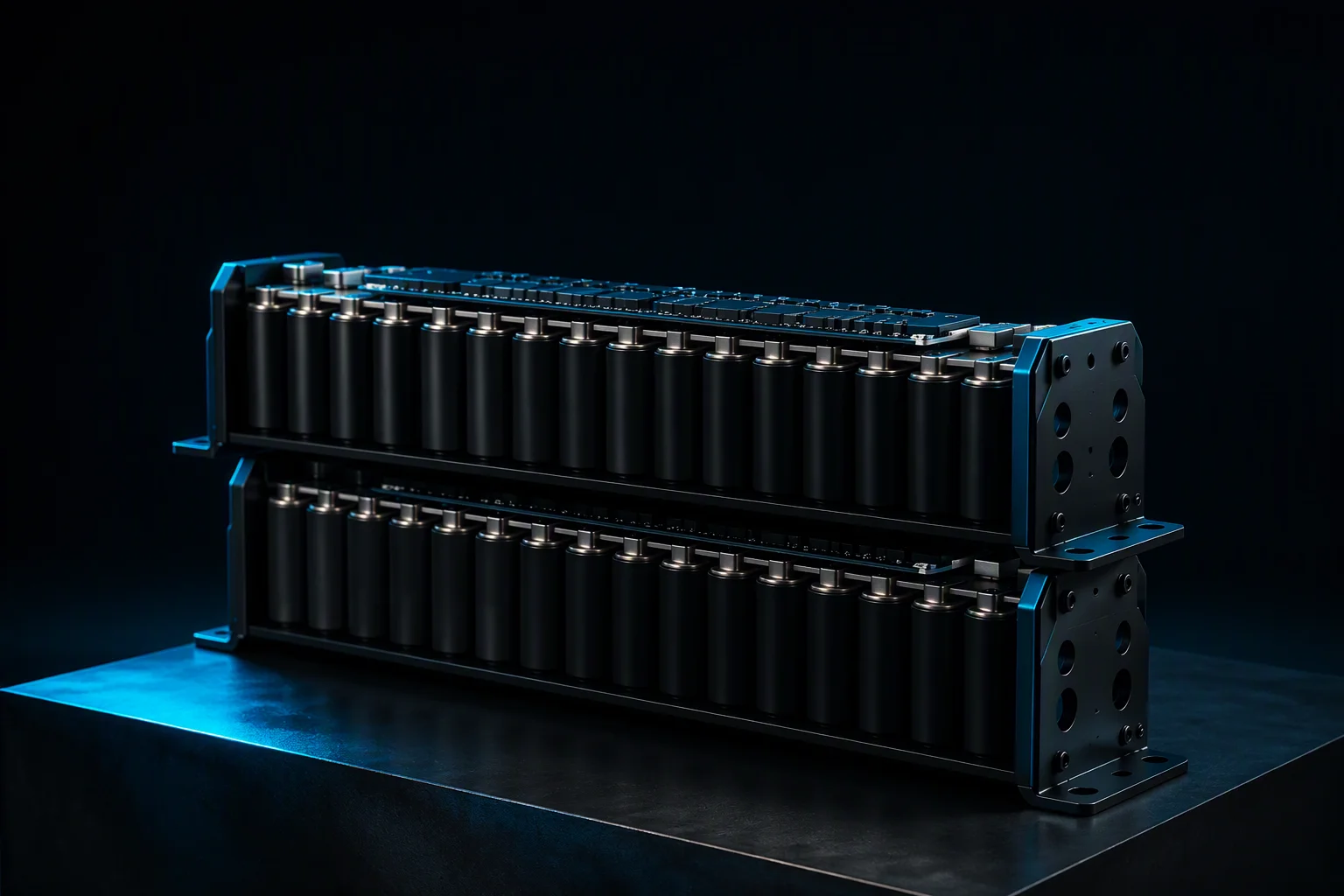
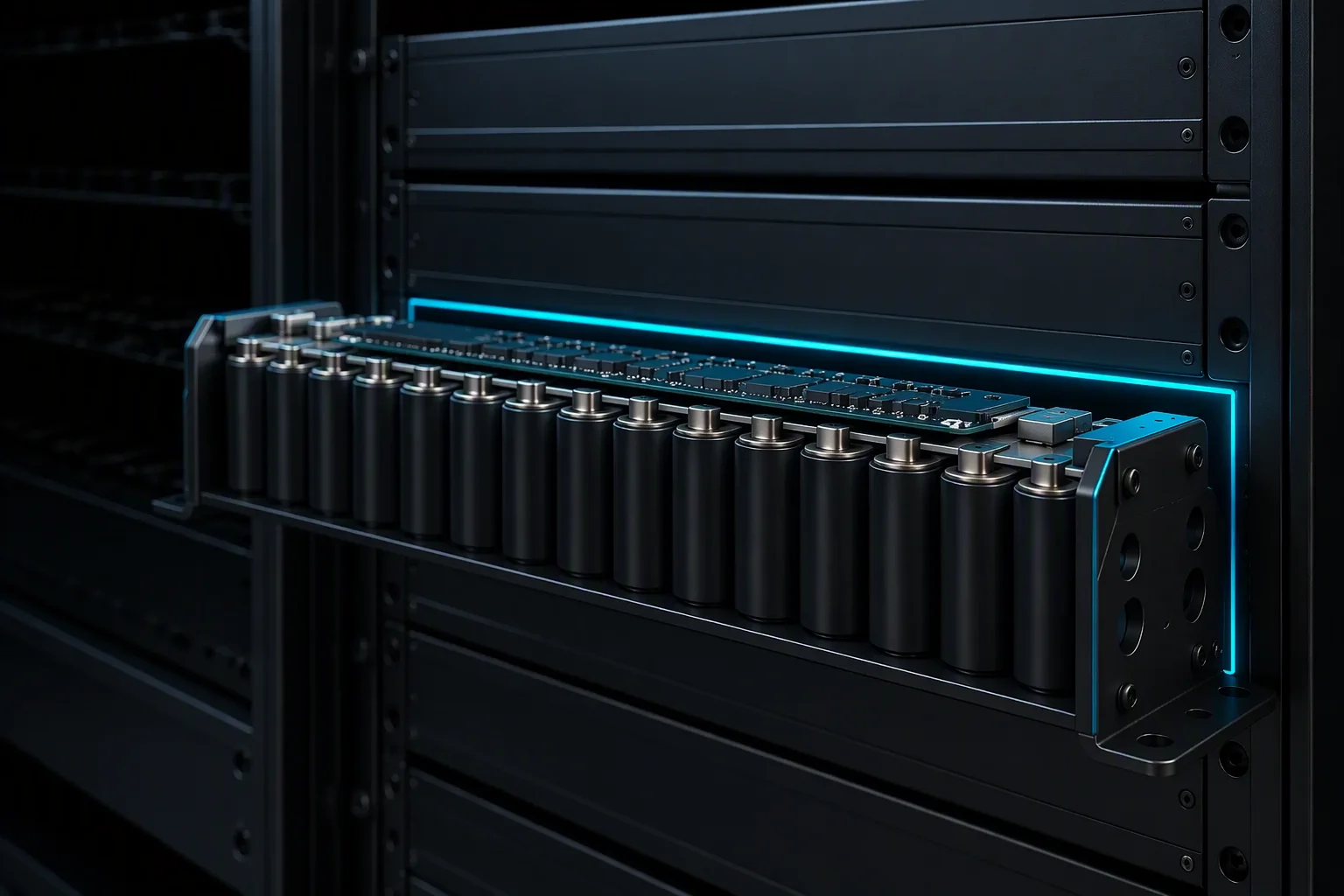
A module qualified for a 15-year design-life class changes the shape of that line item. It does not remove maintenance — nothing electrical is truly maintenance-free — but it converts a recurring campaign into a one-time installation with condition monitoring behind it. That is the same posture our rack modules are specified for: sealed shelf, no scheduled replacement inside the class, and per-cell telemetry so the health question is answered by data rather than by a calendar.
What disappears from the maintenance plan, and what does not
It is worth being precise here, because "maintenance-free" is a phrase that gets overused on both sides of this comparison.
- Gone: watering and electrolyte checks, equalization charges, the periodic deep-capacity test that exists only to decide whether a string still has enough left in it, and capacity-replacement campaigns inside the service life.
- Gone: dedicated thermal management whose only job is keeping storage inside a narrow comfort band — and the parasitic load and failure mode that come with it.
- Still there: a commissioning baseline. Every module ships with a test report carrying its measured capacitance and DC ESR against its serial number, which is what makes later drift measurable.
- Still there: monitoring. Per-cell voltage and NTC temperature over CAN, with three-level over-charge, over-discharge and over-temperature alarms ending in a hard error output. Sleep draw stays below 20 µA between events.
- Still there: periodic inspection — visual, thermal and connector torque checks on the same cadence as the rest of the cabinet.
The trade being made is labour for instrumentation. A supercapacitor installation is not one you forget; it is one you watch with data instead of visiting with a test set.
Temperature tolerance is where the argument is usually won
Every chemical storage technology ages faster when it is hot, and the rule of thumb for batteries is brutal: life roughly halves for every 10 °C of sustained temperature rise above a mild reference. That single relationship is why so many battery-backed installations end up with air conditioning whose real purpose is protecting the batteries, not the electronics. In an unheated hall or an outdoor cabinet, the same relationship runs the other way in winter: lithium-ion charging is typically restricted below 0 °C, and usable capacity collapses toward −20 °C, which is why cold sites bolt on heater mats and the control logic that manages them.
LIC chemistry takes both ends of that range without assistance: −40 °C to +70 °C depending on series, cold cranking at the bottom of it, and no thermal-runaway mode anywhere in the chemistry, because charge is stored by physical adsorption at the carbon electrode rather than by a reaction that can run away. For wind pitch, port machinery, rail and outdoor telecom cabinets, that removes a heater, removes an air conditioner, and removes the maintenance visits that keep both alive. The pitch application note works the cold-site case through in detail.
Where the battery tier still wins, and why hybrid is the real answer
Energy per unit of cost and volume is the battery's home ground, and nothing here changes that. If the requirement is minutes to hours of autonomy, a lithium battery is the correct answer and a capacitor bank would be an absurdly large object. Our own rack architecture says so: LIC for the 1–50 ms tier, battery BBU for seconds to minutes, grid generation for the 1–90 minutes it needs to ramp.
The economics of that layering are better than either technology alone. A battery that never sees the millisecond spike is a battery whose cycle count and peak current both drop, and both of those drive its replacement interval. Putting the capacitor in front does not only cover the fast event; it extends the life of the storage behind it. If you are modelling TCO, that interaction belongs in the model rather than in a footnote.
A fifteen-year comparison without a price list
Published unit prices age badly and vary by lane, volume and enclosure, so the table below compares cost drivers instead of currency. It is the structure a procurement model needs; fill in your own numbers per line.
| Line item | LIC module in the short-duration tier | Battery string in the same seat |
|---|---|---|
| Replacement events over 15 years | None inside the design-life class | Driven by calendar aging and temperature |
| Scheduled maintenance | Inspection plus telemetry review | Capacity testing, replacement campaign planning |
| Thermal provisioning | None dedicated; −40…+70 °C envelope | Heating below 0 °C, cooling to slow aging |
| Parasitic load | < 20 µA standby | Heater and thermal management duty |
| Access cost per intervention | Installation baseline only | Recurring, and multiplied at height or offshore |
| Condition evidence | Per-module test report plus CAN telemetry | Periodic test data, often manual |
| Transport and handling | UN 3499 Class 9, IATA A186 / PI 971 | UN 3480 / 3481 with state-of-charge rules |
| End of life | WEEE take-back route with disassembly guidance | Battery recycling stream |
| Dominant cost driver | First cost per delivered joule-hour | Replacement frequency and site access |
Warranty terms follow the same logic as the aging curve, which is why we state them per quotation rather than as a blanket number: operating voltage window, ambient temperature and cycle duty set how fast a module actually ages, and a fixed term quoted without those three inputs would be marketing rather than engineering. Agree the duty profile and the term is fixed in the order confirmation.
Run the comparison on your own numbers
Seven inputs decide which tier belongs in your cabinet, and all seven are things your site already knows.
- Events per day at the storage tier you are pricing — this is the single most decisive number.
- Window length per event, from 1–50 ms transients to multi-second protection duty.
- Peak power and whether the load is constant power, current or resistance.
- Ambient minimum and maximum, and whether the enclosure is heated or conditioned.
- Access cost per intervention, including any crane, permit or outage window.
- Service-life target for the surrounding equipment — a 20-year asset and a 6-year consumable should not share a design.
- End-of-life route already agreed for the storage you are replacing.
Send those seven lines and the reply names the tier, the module and the capacitance class within 48 hours. If your bus voltage sits between the standard lines, the 16–108 V ODM route builds the same sorted, laser-welded modules to your series count, first article in 8–12 weeks.
Related
Keep reading
CHEMISTRY
Choosing the backup cell: LIC vs EDLC vs Li-ion
The datasheet comparison behind this cost argument.
DESIGN
Sizing a module for ride-through
Energy, window, current check and derating — with two worked examples.
TEMPERATURE
Cold start at −40 °C
ESR rise, capacitance fall and how to specify for unheated sites.

Model it once, properly
Tell us the duty cycle. We will price the tier.
Events per day, window length, ambient extremes and access cost — the engineering reply lands within 48 hours with the assumptions written out.