What UL 810A actually is
UL 810A is the UL standard written for electrochemical capacitors — the component-level document that covers supercapacitor cells. It deals in the questions a cell has to answer on its own: how it is constructed, how its ratings are established and declared, how it is marked, and how it behaves under electrical, mechanical, thermal and abnormal-condition testing. In North American programs it is the recognized entry point for the component, which is why our cells are sourced through UL 810A-recognized capacitor cell routes.
It is equally important to be clear about what the standard is not. UL 810A is not a certificate for a finished module, and it is not an approval for your rack, your cabinet or your UPS. It evaluates a cell as a component. Everything that gets added afterwards — the series string, the welded busbars, the management electronics, the enclosure, the insulation system, the connectors — is a new assembly with new failure modes, and it needs its own evidence. Buyers who treat the cell route as a complete answer usually discover the gap during their own end-product evaluation, when it is expensive.
Why the cell route still matters commercially
A recognized cell route shortens everything downstream. When a component has already been evaluated for construction and abnormal-condition behaviour, the reviewer working on your end product does not have to re-open those questions from scratch — the component arrives with a file rather than a promise. For a program selling into North America, that difference is measured in schedule, not in paperwork.
For a module manufacturer the practical consequence is a sourcing rule rather than a marketing line: cells come from tier-1 manufacturers on recognized routes, and the module work then has to be good enough that the cell evidence is not wasted. A recognized cell welded into an unqualified string is a component file attached to an unknown assembly.
Cell-level evidence versus module-level evidence
The two bodies of evidence answer different questions, and a serious specification asks for both. The table sets out what each one carries and which document proves it in a shipment.
| Question | Cell route covers | Module level has to prove |
|---|---|---|
| Construction and materials | Cell build, internal construction, materials declaration | String assembly, busbar joints, enclosure, insulation system |
| Ratings and marking | Voltage, capacitance, ESR class, temperature class | Module nameplate, series count, terminal identification |
| Electrical behaviour | Cell capacitance, ESR, leakage, self-discharge | String capacitance and DC ESR measured on the finished unit |
| Abnormal conditions | Cell behaviour beyond its ratings | Protection logic, alarm tiers and hard error output |
| Mechanical | Cell-level mechanical robustness | Vibration endurance and terminal pull and bend on the assembly |
| Thermal | Cell temperature class | Characterization sweep across −40 … +70 °C on the module |
| Insulation | Not a module property | Dielectric withstand, AC 2000 V for 1 minute |
| Series-string integrity | Not a cell property | Balancing function, per-cell sensing, module-to-module balance |
| Transport classification | Cell energy figure | UN 3499 Class 9 documentation and packaging for the assembly |
The module gates that carry the qualification
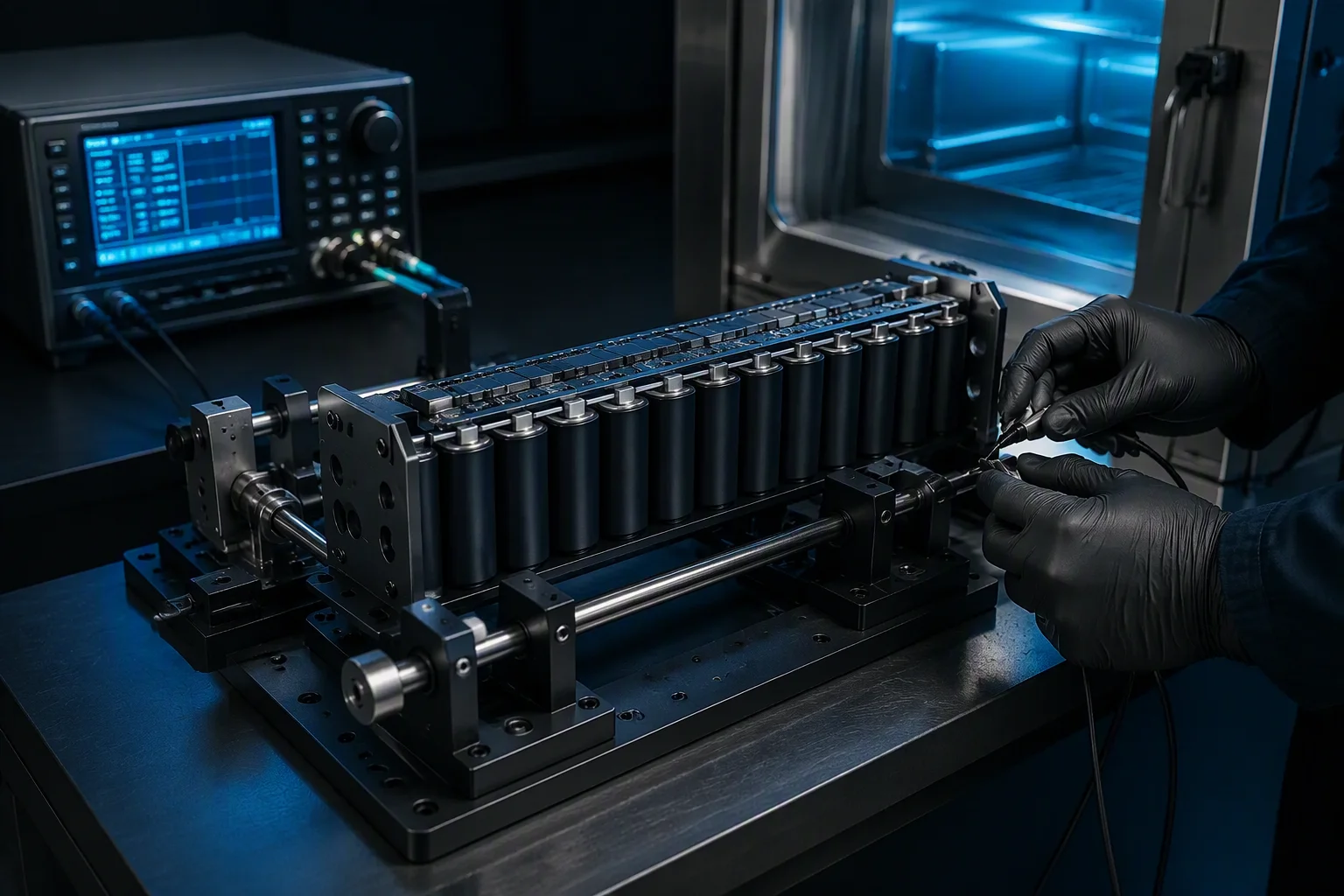
Module qualification is where a capacitor bank becomes a product. The gates below are the ones our line runs on every finished unit, with methods referenced to IEC 62391 and the results logged against the module serial number.
- Capacitance and DC ESR measured on the assembled string, with the cells behind it C/ESR sorted to a ±5% window before welding.
- Leakage current and self-discharge: held at rated voltage, then a 72-hour open-circuit rest that has to retain ≥3.7 V at cell level.
- Temperature characterization: a chamber sweep across the −40 … +70 °C series envelope, producing the derating curve your sizing work depends on.
- Dielectric withstand: AC 2000 V for one minute between busbar assembly and chassis, on every module.
- Balancing function: a deliberate imbalance injected at BMS level, then proof that the string rebalances and that module-to-module auto-balancing works in a parallel stack.
- Alarm and telemetry: over-charge, over-discharge and over-temperature conditions injected to confirm the three-level alarm ladder ends in a real error output, with per-cell voltage and NTC temperature readable over CAN 2.0B.
- Dormancy: sleep-state draw verified below 20 µA, which is the difference between a backup that is still charged in year three and one that quietly drained.
- Surge: a >500 A class pulse under 5 s with parameters re-measured afterwards, plus vibration and terminal strength checks on the shipped mounting arrangement.
None of these is a UL 810A test, and that is the point. They are the module-level questions the cell file cannot answer, and they are documented in the quality and certification set rather than asserted in a brochure.
Where the rest of the compliance stack sits
Around the core standard sit several other documents, each owned by a different question. Mixing them up is a common source of confusion in submittals.
| Document | What it answers |
|---|---|
| UL 810A cell route | Component-level safety and construction for the cells inside the module |
| IEC 62391-1 / -2 methods | How capacitance, ESR and leakage are measured; the basis of the test report |
| IEC 62576 | Test methods for electrochemical capacitors in road-vehicle applications |
| AEC-Q200 | Passive-component qualification route for automotive programs |
| RoHS, REACH, WEEE | Substance compliance across the bill of materials and the end-of-life route |
| CE Declaration of Conformity | EU market declaration for the module — a declaration, not a sticker |
| UN 3499 Class 9 documents | Transport of cells and modules above 0.3 Wh, IATA A186 / PI 971 by air, on a 10 Wh-or-less per-cell basis |
The evidence pack to request with a first order
A buyer does not need to become a standards expert to test these claims. Six requests separate a documented product from a described one, and all six should be answerable before the first purchase order is issued.
- A sample module's per-unit test report, with the serial numbers of the cells inside that specific unit.
- The measurement method the report references, so your own incoming inspection can reproduce it.
- The temperature characterization data behind the published operating envelope, not just the envelope.
- The dielectric withstand result for the unit you are buying, not a generic type-test statement.
- The declaration set you need for your market: RoHS, REACH, WEEE and the CE Declaration of Conformity where applicable.
- The transport documentation you will need at the border: UN 3499 Class 9 papers, with the IATA basis confirmed for air freight.
How to sequence certification work in a program
Compliance is rarely the critical path when it is started early and almost always is when it is started late. Four stages keep it parallel rather than sequential.
| Stage | What runs | What closes it |
|---|---|---|
| Specification freeze | Bus voltage, window, duty and derating assumptions agreed | RFQ reply within 48 hours naming the module and class |
| Sample and first article | Samples ship in 4–6 weeks on standard lines, 8–12 weeks for a custom first article | Per-module test report reviewed against your acceptance criteria |
| Rack or cabinet evaluation | Your end-product evaluation proceeds with the module data in hand | Module datasheet, test report and declaration set in the submittal |
| Production | 100% final test, serial-linked records, cell traceability retained | Report in every carton plus UN 3499 shipping documents |
Red flags in a certification claim
Compliance language is easy to inflate, so it is worth knowing what inflation looks like when it appears in a quotation or a datasheet.
- A module described as certified to a cell standard, with no module-level test data offered.
- A test report with no serial number, no date and no cell list — a design document wearing a report's clothes.
- Temperature claims without a characterization curve, on a product sold into unheated cabinets.
- Transport paperwork promised "on request" for cells and modules that exceed the 0.3 Wh threshold.
- A CE claim presented as a third-party certificate rather than a declaration of conformity.
Ask for the documents, not the adjectives. If your program also needs automotive-grade evidence, the same module family is quotable against IEC 62576 methods and an AEC-Q200 component route — and if the answer has to arrive before your next design review, the RFQ desk turns a document request around inside 48 hours.
Related
Keep reading
QUALITY
Quality system & the eight-name compliance wall
Twelve checks, eight documents and the lab behind every serial number.
QUALITY
Capacitance and ESR binning explained
What the ±5% window means in a series string, and how it is measured.
TECHNOLOGY
Twelve gates between cell and box
The full module test sequence, with methods and acceptance limits.

Documents, not adjectives
Request the evidence pack with your sample.
Test report, methods, declarations and UN 3499 papers — the set arrives with the sample, inside 48 hours of the request.