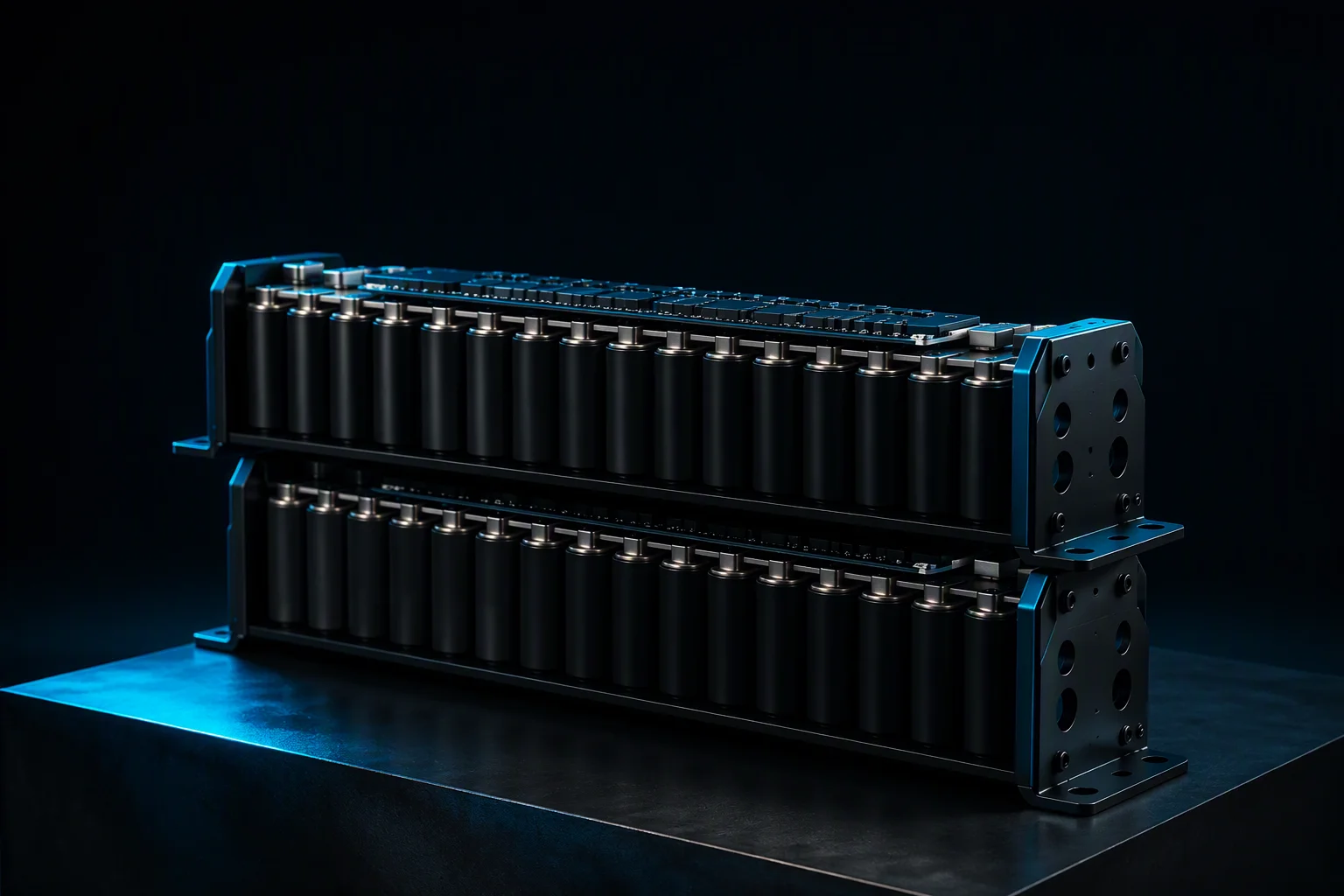
A rack crossed a threshold
The GB300 NVL72 rack draws 132–142 kW and weighs roughly 1,580 kg — and with that generation, energy storage quietly moved inside the power shelf as standard equipment rather than an accessory bolted to the side of the rack. That is the part of the GB300 story most component buyers feel first: the rack no longer draws every watt it burns in real time.
The published numbers make the scale plain. NVIDIA's own GB200/GB300 documentation credits rack-integrated storage with cutting grid peak demand by up to 30%, because capacitors in the power supplies absorb the workload's swings locally instead of letting them propagate to the facility feed.
65 joules per GPU, half the PSU volume
The headline spec is small on purpose: 65 J of energy storage per GPU, held in capacitors that occupy about half the volume of each power supply. That is enough to charge fast on light phases of GPU work and discharge on heavy ones — smoothing second-scale power swings without ever pushing energy back toward the grid.
Why capacitors rather than a battery in that seat? Because the workload pulses in milliseconds, and capacitors answer in kind. The grid, by contrast, needs 1–90 minutes to ramp generation up or down. Everything between one millisecond and ninety minutes is a gap that has to be absorbed inside the rack — and no single device covers it, which is where the tiered architecture comes in.
The three tiers of AI rack power
| Tier | Time window | Job |
|---|---|---|
| LIC supercapacitor modules | 1–50 ms | Absorb transients, shave peaks, hold the bus through GPU load steps |
| Battery BBU (1U lithium) | Seconds – minutes | Bridge outages and sustained excursions while larger systems wake |
| UPS / HVDC + grid | Minutes and up | Facility ride-through while generation ramps to meet demand |
Training telemetry explains why the first tier is not optional. The Llama 3 405B pre-training log — 54 days on a 16,384-GPU cluster — records 419 unexpected interruptions, 58.7% of them traced to GPU hardware. Every millisecond dip the capacitor tier absorbs is checkpoint integrity you do not have to buy back with re-runs.
What the supply chain did next
GB300-class power supplies now ship with LIC modules integrated, and the component ecosystem moved with them: rack-mounted, high-power LIC module lines were announced for the second half of 2025 GB300 ramp, and industry analysts logged the moment supercapacitors entered the AI power bill of materials as a standing line item rather than a design study.
For buyers this matters at the module layer. Cells do not slot into a power shelf by themselves — someone sorts them, welds the busbars, wires the balancing and monitors every series string. That layer has become a sourcing decision in its own right, separate from the choice of cell.
If you are spec'ing a shelf
The questions are concrete: how many joules per shelf, over what window, at what bus voltage, and with what telemetry. Our RackBridge 48V module is built for exactly that layer — 48.6 V / 166 F class, 130 A continuous, per-cell telemetry and a test report in every box. For the full three-tier stack with workload and outage numbers, see the AI data center industry page; and if you are still choosing between chemistries for the millisecond tier, the comparison note below runs the datasheet figures side by side.
Related
Keep reading
CHEMISTRY
Choosing the backup cell: LIC vs EDLC vs Li-ion
Ten datasheet rows that decide which chemistry owns the ride-through seat.
MANUFACTURING
Inside a supercapacitor module line
Six stations from IQC to 100% final test — where ±5% module consistency is made.
INDUSTRY
AI Data Center ride-through & peak shaving
The full three-tier power stack with interruption and ramp-time numbers.

GB300-class shelf in your queue
Send the joule budget. Get a module count.
Power per shelf, ride-through window, bus voltage — three numbers are enough for a 48-hour engineering reply with capacitance class and lead time.