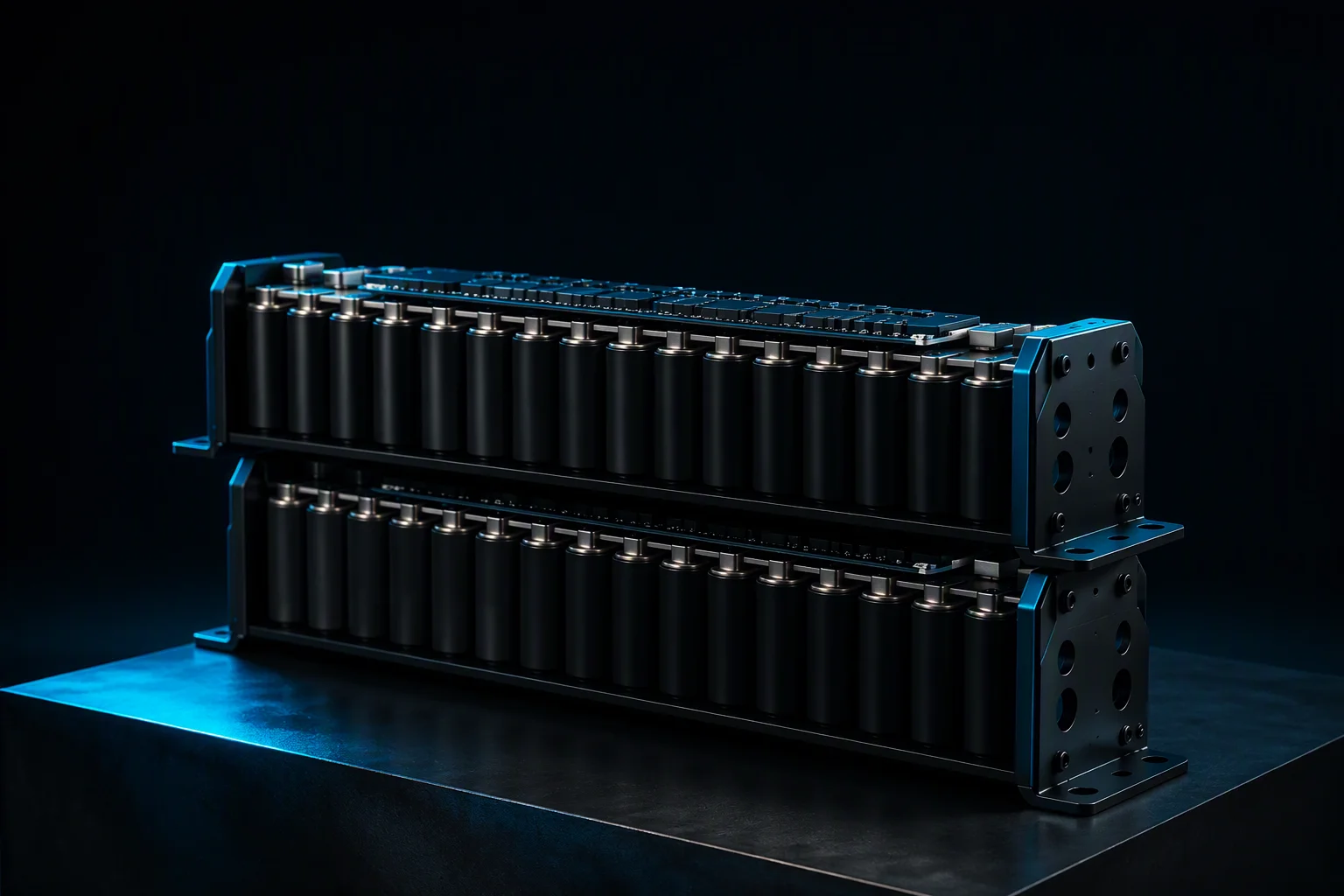
Cells arrive as strangers
A supercapacitor module starts as a tray of bare cells from a tier-1 manufacturer — good cells, but strangers to each other. Factory tolerance on capacitance runs from −10% to +30%, which means two cells from the same box can differ by a third of their rated capacity. Put them in series unsorted and the weakest cell sets the string's ceiling while the strongest sits half-idle. Everything a module line does flows from fixing that one problem.
Station one and two: IQC, then sorting
Incoming inspection logs every cell lot against its certificate before anything touches a fixture — documentation, date codes, terminal condition. Then the automated sorting line measures each cell on two parameters at once: capacitance and ESR. Dual-parameter binning is what turns the −10/+30% factory spread into a module window of ±5%, and it is the single biggest quality lever between cell and rack.
| Station | What happens | QC gate |
|---|---|---|
| IQC | Incoming cell lots inspected and logged | Documentation and parameter match |
| Capacity sorting | C/ESR dual-parameter test, binning | ±5% module window |
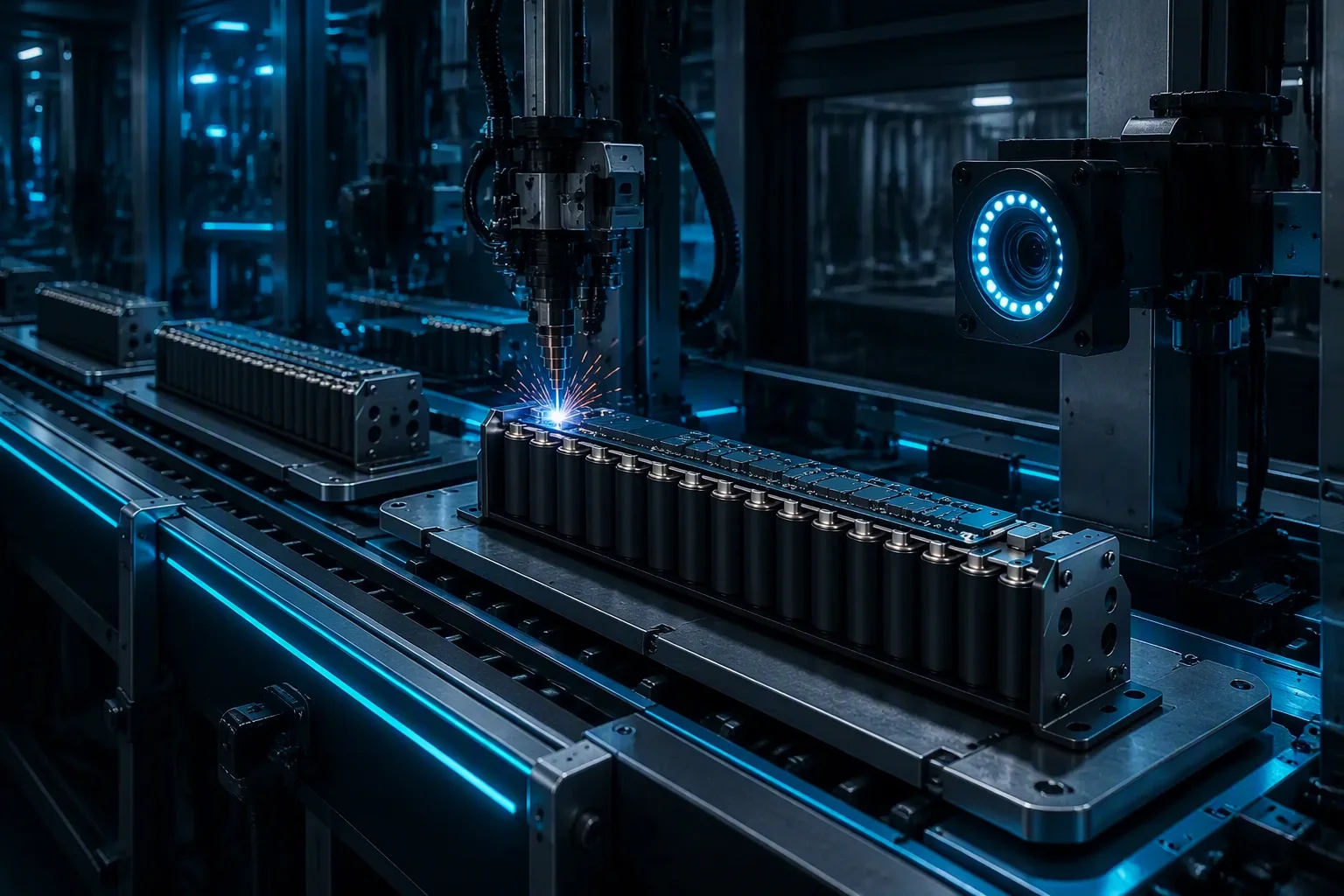
| Laser welding | Busbar links welded cell to cell | Weld seam inspection |
| BMS assembly | Balancing, per-cell sense, alarms, CAN | Functional board test |
| Aging | Formation cycles and burn-in | Drift within limits |
| Final test | 100% electrical verification | Per-module test report, ship |
Station three: laser welding the busbars
Modules live or die at their joints. Cable-and-lug assemblies add resistance, inductance and a maintenance item; the line welds nickel busbar links directly across cell terminals with a laser — weldable-terminal cells on one fixture class, welded-post large cells on another. A consistent weld seam keeps the milliohm budget honest, which matters when the module's whole job is moving 130 A continuously and 500 A-class surges without heating unevenly.
Station four: BMS and the alarm ladder
The management board goes on top with three jobs. First, balancing — resistive, passive or active per the order — holding every series cell inside its window and auto-balancing module-to-module in parallel fleets, with board sleep current under 20 µA. Second, telemetry: per-cell voltage plus module temperature, CAN on high-voltage builds. Third, protection: three-level alarms for over-charge, over-discharge and over-temperature, ending in a hard error signal output the host system can act on.
Stations five and six: aging, then proof
Aging runs formation cycles and burn-in so infant failures surface here instead of in your rack. Dielectric integrity is verified at AC 2000 V for one minute. Then every module — not a sample, every module — goes through 100% final electrical test, and the numbers go in the box: a per-module report with capacitance and ESR logged against serial number, traceable back through the sorting data to the original cell lot. That paper trail is what makes a field return a five-minute lookup instead of a mystery.
The factory page tours the line station by station, and the testing & sorting page details the full IEC 62391 test set behind the ±5% claim.
Related
Keep reading
AI POWER
Why GB300 made supercapacitors standard in AI racks
65 J/GPU, 30% peak shaving and the three-tier rack power stack.
CHEMISTRY
Choosing the backup cell: LIC vs EDLC vs Li-ion
Ten datasheet rows that decide which chemistry owns the ride-through seat.
FACTORY
Inside the CapStack module factory
The line, the sorting cabinets and the capacity behind every module order.

See the line yourself
Ask for the test report before the quote.
We will send a sample module's per-unit report with any RFQ reply — capacitance and ESR, logged to serial, within 48 hours.